


The Best SUP Boards in 2025 - How to find a new SUP board. Which inflatable SUP board is best for you? There are several considerations you should consider. That's why we've put together this blog post to help you find the best inflatable SUP board that suits your needs and wants.
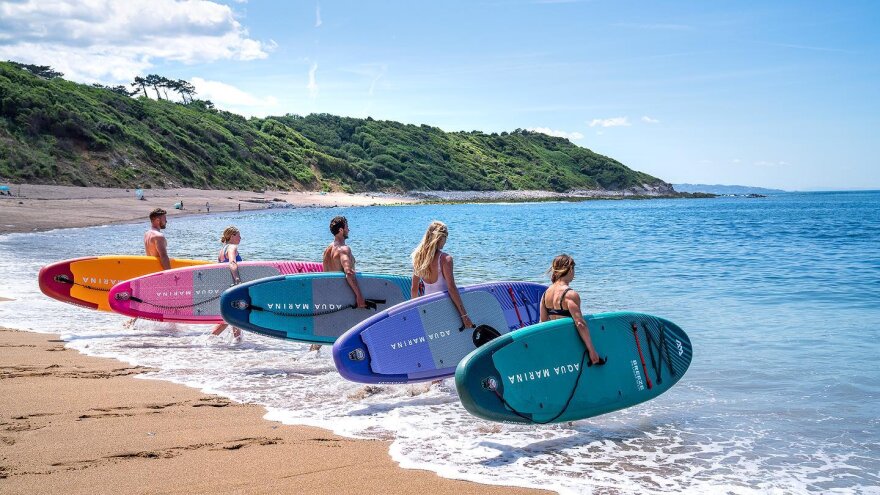
Our picks for the best inflatable SUP boards in 2024
If you are looking for the perfect way to get out on the water and experience nature in a new way, then stand up paddleboarding (SUP) is the obvious choice for you.
Which inflatable SUP board is best for you? – There are several considerations you should consider. That's why we've put together this blog post to help you find the best inflatable SUP board that suits your needs and wants.
We will take you by the hand through the best inflatable SUP boards on the market, give you tips and tricks for choosing equipment, and share our own experiences. Whether you know a little about SUP, or are completely new to this world, this blog post will help you understand what you need to know to choose the best inflatable SUP board.
Below you will find our recommendations on affordable SUP boards , Top quality SUP boards for fun and games and SUP boards for the advanced user.
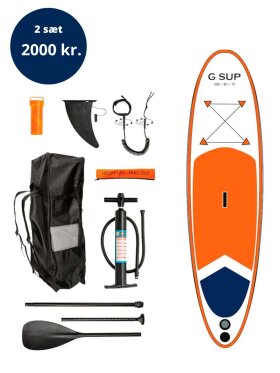
The affordable SUP boards:
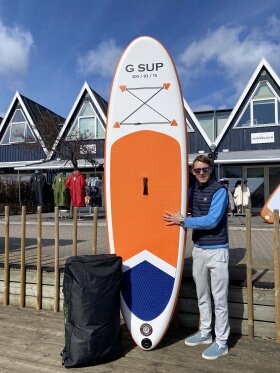
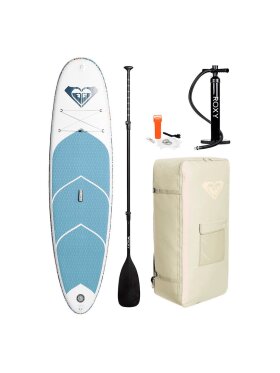
Four suggestions for good quality boards for fun and games:
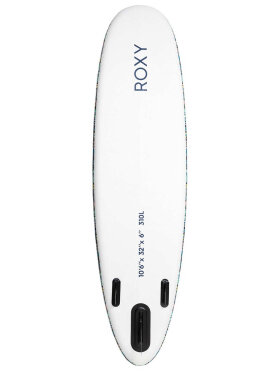
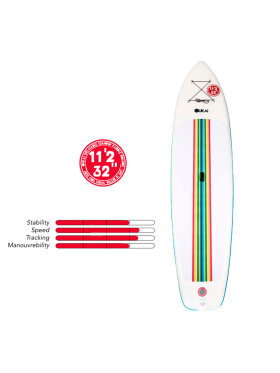
Two board suggestions for the experienced:
Why inflatable SUP boards?
The inflatable SUP boards have two primary advantages.
-
Handling: An inflatable SUP board is much easier to handle than a fixed board. This is because the board can be folded up so that it can be put in a sports bag, or in the backpack that most inflatable boards come in. The board is also relatively light and therefore easy to take with you to the beach or on vacation.
-
Price: Inflatable SUP boards are significantly cheaper than traditional hardboards. While inflatable boards have a price point of around 1500 - 8000 kroner, hardboards start at around 8000 kroner and up. For those who want to use the board for family fun, or want to try the sport, inflatable boards are ideal. If you are already experienced, there are also better inflatable boards that can provide more challenge and more speed.
If you are considering buying an inflatable SUP board, there are some important factors you should consider:
-
Size: It is important to choose a size that suits your weight, skills and the purpose you want to use the SUP board for. There are two aspects you need to pay attention to.
- Length of the board: The length of your SUP board helps give you speed and directional stability. The longer your board, the more directional stability it will have. For fun and exercise, we recommend a length of about 10-13 feet.
- The width of the board determines the stability: The wider the board, the more stable it will be. The disadvantage of wide boards is that they are slower and heavier to get through the water. For beginners, we recommend a width of approximately 32 to 35 inches, corresponding to 83-90cm. For experienced and sporty SUPers, a width between 30 and 32 inches is recommended, while anything under 30 inches is better suited for racing and long-distance sailing.
-
Materials and quality: Make sure to choose a high-quality board that is made of strong and durable materials that can withstand shocks, impacts and wear. This helps to increase your safety on the water and the lifespan of the board. The quality of valves, fins, paddles and handles are also important factors to consider. On good quality boards, these are made of stronger and stiffer materials, while cheap packages tend to have a shorter lifespan, air loss etc.
-
Construction: The technical construction of SUP boards is important to keep in mind, as it has a great impact on performance. An inflatable SUP board is made of plastic and glue, but to make it stiff, the top and bottom are joined together with "dropstitch" inside the board. The amount of dropstitch and the method by which they are attached help to stabilize and stiffen the board. A board in glued dropstitch will be cheaper, but heavier and softer, than boards in woven dropstitch.
Another way to improve the construction is by adding more layers of plastic to the top, bottom and side wales, or by adding "stringers" along the length of the board. These strings can be made of plastic, fiberglass or carbon. Both strings and extra plastic material help to stiffen the board. The stiffer the board, the easier and more fun it is for both beginners and experienced riders.
-
Price: Inflatable SUP boards can vary greatly in price depending on construction, material and quality. What basically determines the price difference is the stiffness of the board. The more you pay, the better and stiffer your board will be. This gives better control, better power transfer from the paddle and thus more speed. Make sure to choose a board that fits your budget, but remember that price and quality really do go hand in hand in the SUP world.
-
Height, weight and multiple people: Who will use the board? If there are several users of the SUP board, it is ideal if you are approximately the same height and weight. If you are not the same weight, it is important to go for a board that fits the heaviest person. It is easier for the light person to use an oversized board than for the heavy person to use an undersized one.
If you want to use the board with two people at once, this is actually also possible. In this case, it is recommended to take a board with good width and a high carrying capacity. The larger the board, the easier it will be to keep balance.
-
Accessories: Check what comes with the board. Some inflatable SUP boards come with accessories such as a pump, backpack, paddle and repair kit, while others do not. This can affect the overall cost and what you will need to buy extra.
ALWAYS REMEMBER TO BRING A CE APPROVED SWIMMING / LIFE JACKET.
Different styles and activities
- Surfing: SUP surfing is an exciting and challenging style of surfing where you ride the waves on a SUP board. It requires good balance and the ability to maneuver the board in the waves, which is why it is not for beginners. If this is what you want a board for, it is recommended to buy a hardboard.
- Touring: SUP touring is a more relaxed style of paddling, where you go on long trips on your board. These boards are often longer and narrower, which provides good speed and directional stability. Boards around 12 feet and 30 inches wide are recommended.
- Yoga: SUP yoga is a popular style where you practice yoga on a SUP board in calm water. It requires good balance and strength, but it is a fun and different way to practice yoga. For this, a board with plenty of width is recommended.
- Fitness: SUP fitness is a relatively new style where you use a SUP board to train different muscle groups and increase your fitness. This can include everything from strength training to cardio exercises and balance exercises. Depending on how you want to practice this style, different boards are ideal. However, you will always benefit from an all-round board.
- Race: SUP racing is a style of competition where you compete on a SUP board against other racers. It requires good technique, good balance and good speed, as you have to navigate quickly through the water. For this, a carbon hardboard is recommended, with a length of +14 feet and under 30 inches in width.
No matter which style you choose, it is important to choose the right board and accessories that suit the activities on the board.
What pumps are available?
There are several different types of pumps that can be used to inflate a SUP board. One of the most common is hand pumps, which are often included in package deals. In addition to hand pumps, there are also:
- Electric pumps : Electric pumps use a built-in motor to inflate the board faster and more efficiently than hand pumps. These are ideal if you have a car as they usually require a power connection.
- Battery-powered pumps: Battery-powered pumps work in the same way as electric pumps, but they use a rechargeable battery to power the motor. These are portable and convenient for use in places where there is no access to electricity – ideal if you are going to the water, lake or stream by bike or on foot. However, these types of pumps are relatively more expensive.
- Hand pumps: Hand pumps are a manual type of pump that requires you to step on a footplate and pump up and down with the handle. These are often included with the purchase of a SUP board. Hand pumps are available in different qualities and can be both one-way and two-way. We recommend a good quality two-way pump as this helps to ease your workload.
It is important to choose the right type of pump that suits your SUP board and your needs for use. Most inflatable SUP boards come with a suitable pump or adapter, but it may be a good idea to invest in a better pump. This upgrade can be for a better hand pump, or an electronic one.
Must-have equipment for SUP
If you are a beginner or more experienced, and want to have the best experience on your SUP, there are simply some accessories that can make your trip safer, more comfortable and more practical. We have compiled this list of must-have accessories.
- Life jacket/swim jacket : In Denmark, SUP-board is categorized as a vessel, which is why it is a legal requirement to have one CE approved life jacket that fits you on the water. In addition to the legal requirements, a life jacket is important for your safety on the water, regardless of whether you are a beginner or experienced. It is important to choose a life jacket that fits your size and weight, and that is comfortable to wear. The vest can be either inflatable or like a traditional swimming/life jacket.
- SUP paddle : A good SUP paddle is essential for any SUP trip. It is important to choose a paddle that suits your height. However, most paddles have a telescopic function where it can be adjusted to your height. A good paddle is stiff and light. This provides better power transfer, while you need to use less effort to paddle.
- Leash : A SUP leash is a safety line that prevents your board from floating away from you in the event that you fall into the water.
- Finn : The fin is important for that sailing. Without the fin there is nothing to stabilize the board and you will have difficulty steering.
Nice-To-Have equipment for the SUP
In addition to the above things that are "must-haves", there are also some things that are quite nice to have.
- Board bag: A board bag is a practical way to transport your SUP board. It protects the board from damage during transport and storage and makes it easier to carry around.
- Waterproof bag : A waterproof bag is a great way to store your personal belongings, such as your cell phone, keys, and sunglasses straps. This is especially important if you plan on taking longer trips, or it might also be a good idea to have a waterproof cell phone case so you can make emergency calls in the event of an accident.
- Sunglasses : Sunglasses protect your eyes from UV rays and reflected light from the water. It is important to choose sunglasses with polarized lenses to reduce reflections from the water.
- Sunscreen or rash guard : Sunscreen is important to protect your skin from harmful UV rays. It is important to choose a sunscreen with a high SPF value and to apply it regularly during the day. As an alternative to sunscreen, a rashguard / UV t-shirt can be used. This has a sun filter built into the shirt so you don't have to wear sunscreen.
What size board should I get?
When finding the right SUP board, it is important that you find one that has a load capacity that suits your weight. Most boards have two weight measurements. One is a recommended rider weight and the other is the board load capacity. You need to find a board where the optimal rider weight is higher than your own weight. The more load capacity the board has, the more stable it will be.
When choosing a board, there are 3 key factors that determine the board's carrying capacity:
-
Board construction: The stiffer the board is constructed, the more load-bearing capacity it has.
-
Board width: The wider the board, the more it can carry and provides better balance.
- Board length: The length of the board can also provide more carrying capacity. However, it is not useful to take a 14-foot board, as this will be narrow and therefore unstable.
When choosing a board, you need to find the golden mean between the three factors above.
Are a wetsuit and neoprene shoes a necessity?
No, a wetsuit is not a necessity, but in Denmark it can give you significantly more days on the water. This of course depends on several factors, including water and air temperature, wind conditions, your planned activity, and how long you want to be in the water.
If the water is cold or you plan to be in the water for a long time, it may be a good idea to wear a Wetsuit . A wetsuit helps keep your body warm by insulating you from the cold water. In addition, the wetsuit can protect your skin from the sun.
Neoprene shoes may also be a good idea to wear, especially if you want to avoid cutting or damaging your feet on sharp objects on the bottom of the water, and to keep your feet warm.
If the water is warm and you don't plan on being in the water for a long time, you may not need a wetsuit and neoprene shoes .
5 simple beginner tips for those who want to start SUP
Here are five simple tips for beginners who want to start stand up paddleboarding (SUP):
-
Take a lesson: If you are completely new to SUP, it can be a good idea to take a lesson with an experienced instructor. An instructor can show you how to paddle properly, how to control your board, and give you some useful tips and tricks to get you started. It can also be a good way to learn about safety and local conditions.
-
Be aware of water and wind: When you first start SUPing, you should start in calm water with minimal current or waves. This will make it easier for you to find your balance and become comfortable standing on your board. Be careful not to go out into too much wind, especially if it is an offshore wind. An inflatable SUP board acts a bit like an air mattress, so if there is a lot of wind from the shore, you may have difficulty getting back in.
-
Always use a leash and life jacket/life jacket: A leash and a life jacket/life vest are the most important safety equipment when you are on your SUP board. The leash keeps you attached to the board if you fall into the water, and prevents your board from getting caught in the wind or current and flying away from you. The life jacket/life vest will help you stay afloat if you fall off.
-
Paddle with your head up: When paddling, you should keep your head up and look forward. This will help you maintain your balance and avoid falling into the water.
- Be mindful of others: When you are on the water, you should be aware of other people and boats around you. Keep an eye out for other SUPers, kayaks, boats, swimmers, and avoid getting too close to them. Also be aware of local rules and regulations for SUP in your area.
Gumpel & Co is ready to help you
We hope this blog post has been helpful to you in your search for the perfect inflatable SUP board. At Gumpel & Co we are passionate about stand up paddleboarding and want to share our knowledge and experiences with you.
Remember that SUP is an activity that can be enjoyed by everyone, regardless of age or skill level. With the right inflatable SUP board, you can explore hidden beaches, lakes, rivers, and discover nature from a whole new angle.
If you have any questions or need further advice, you are always welcome to contact us. We are always ready to help and share our passion for SUP with you.
So get out on the water, bring your friends and family with you, and create some unforgettable memories on your new inflatable SUP board. See you on the water!